
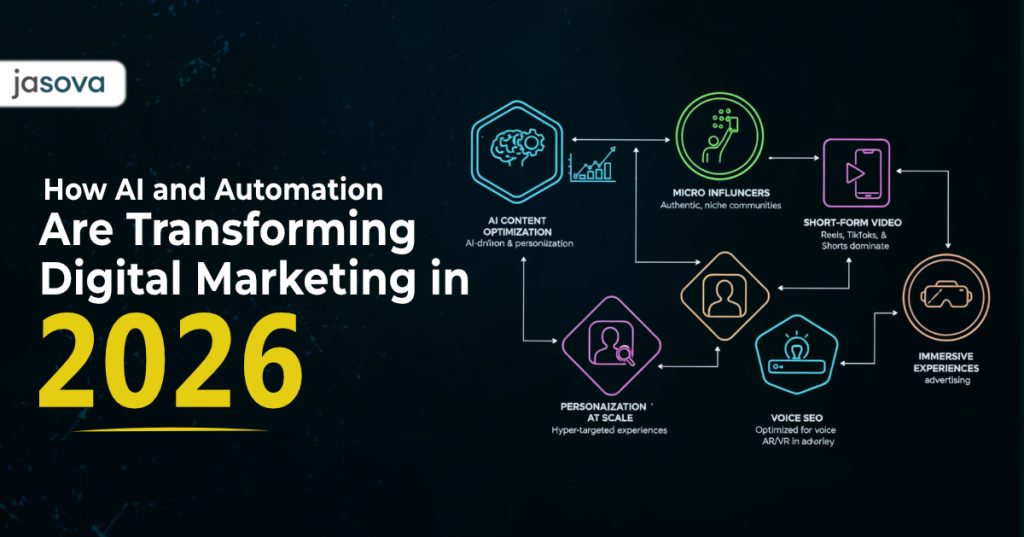
Digital marketing is evolving faster than ever before. In 2026, businesses are no longer relying only on manual campaigns and traditional advertising strategies. Artificial Intelligence (AI) and automation are transforming how brands connect with customers, analyze data, and improve marketing performance.
From AI-generated content and automated ad optimization to chatbots and predictive analytics, modern businesses are adopting smarter technologies to stay competitive. Viral trends such as AI-powered personalization, short-form video recommendations, and automated customer journeys are now shaping the future of digital marketing.
Businesses looking to stay ahead are increasingly partnering with experts like Jasova digital marketing agency in Bangalore, to integrate AI-driven strategies into their digital growth plans.
This blog explores how AI and automation are changing digital marketing in 2026 and why businesses must adapt to remain competitive.
The Rise of AI in Digital Marketing
Artificial Intelligence is no longer just a futuristic concept. It is now actively used in:
- Search engine optimization (SEO)
- Paid advertising
- Social media marketing
- Email campaigns
- Customer support systems
AI helps businesses process massive amounts of data quickly and make smarter marketing decisions in real time.
Modern consumers expect personalized experiences, faster responses, and relevant content. AI enables businesses to deliver exactly that.
How Automation Is Changing Marketing Operations
1. Smarter Ad Campaigns
AI-powered advertising platforms automatically optimize campaigns based on:
- Audience behavior
- Click-through rates
- Conversion data
- User interests
This reduces manual work and improves return on investment.
Businesses searching for the best digital marketing services in Bangalore are now prioritizing agencies that use AI-driven optimization instead of outdated manual marketing methods.
2. Personalized Customer Experiences
AI allows businesses to personalize:
- Product recommendations
- Email marketing
- Website content
- Social media ads
Platforms like Instagram, YouTube, and Google already use AI algorithms to show users highly relevant content based on their behavior.
This personalization improves engagement and increases conversion rates.
3. AI Chatbots and Instant Customer Support
Customer expectations have changed dramatically. Users now expect instant responses at any time of the day.
AI-powered chatbots help businesses:
- Answer customer queries instantly
- Improve response times
- Generate leads automatically
- Provide 24/7 support
Chatbots also reduce operational workload while improving customer satisfaction.
Trending AI Marketing Strategies in 2026
Short-Form Video Optimization
Short-form video content continues to dominate platforms such as Instagram Reels, YouTube Shorts, and TikTok.
AI tools now help businesses:
- Analyze trending topics
- Generate captions and hashtags
- Predict engagement performance
- Optimize posting times
This helps brands create viral content more effectively.
Predictive Analytics
Predictive analytics uses AI to forecast customer behavior and future trends.
Businesses can predict:
- Buying patterns
- Customer preferences
- Campaign performance
- Audience engagement levels
This allows companies to make proactive marketing decisions instead of reactive ones.
Automated Content Creation
AI tools can now assist in:
- Writing blog outlines
- Creating ad copy
- Generating social media captions
- Producing email content
While human creativity remains essential, automation speeds up content production and improves efficiency.
Importance of AI for Business Growth
Businesses that adopt AI and automation gain several advantages:
- Faster campaign execution
- Better audience targeting
- Improved marketing efficiency
- Higher ROI
- Enhanced customer engagement
Companies that ignore AI trends may struggle to compete as digital marketing becomes more data-driven and automated.
Integration of Technology and Marketing
Digital marketing is now closely connected with technology infrastructure. Businesses need websites, CRM systems, analytics tools, and automation platforms that work together efficiently.
Many growing brands also collaborate with a reliable software development company Bangalore contact provider, to build custom platforms, automation tools, and integrated digital systems that support advanced marketing strategies.
This integration creates smoother customer experiences and improves business operations.
Challenges Businesses Face with AI Adoption
Although AI offers significant advantages, businesses may still face challenges such as:
- Lack of technical expertise
- High implementation costs
- Data privacy concerns
- Overdependence on automation
The key is balancing automation with human creativity and strategic thinking.
The Future of Digital Marketing Beyond 2026
AI and automation will continue to evolve rapidly. Future digital marketing trends may include:
- Voice-search optimization
- Hyper-personalized advertising
- AI-generated video campaigns
- Advanced predictive targeting
- Fully automated customer journeys
Businesses that adapt early will have a significant competitive advantage.
Conclusion
AI and automation are transforming digital marketing from a manual process into a smarter, faster, and more personalized system. Businesses that embrace these technologies can improve efficiency, customer engagement, and marketing performance.
In 2026, successful digital marketing is no longer just about being online—it is about using intelligent systems to deliver the right message to the right audience at the right time.