
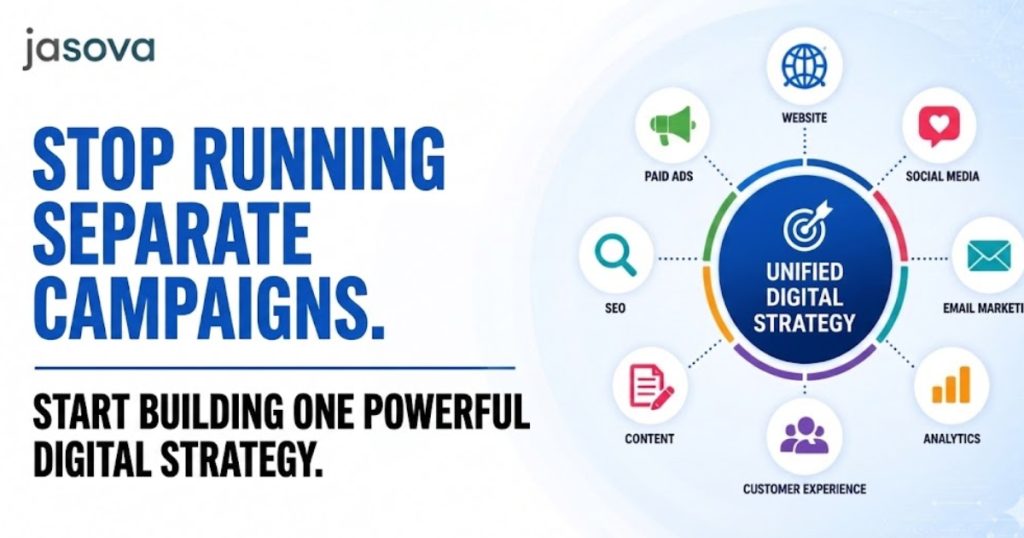
Digital marketing has become more complex than ever. Customers interact with businesses through search engines, websites, social media platforms, online reviews, emails, and digital advertisements before making a purchase decision. Yet many businesses still manage these channels separately, leading to inconsistent messaging and missed growth opportunities.
Today, successful brands are moving toward unified digital strategies that connect all marketing efforts into one cohesive system. Instead of treating SEO, social media, paid advertising, and reputation management as separate activities, businesses are integrating them to create better customer experiences and stronger business outcomes.
Many growing companies work with a Jasova digital marketing agency in Bangalore to build connected marketing strategies that improve visibility, engagement, and long-term growth.
What Is a Unified Digital Strategy?
A unified digital strategy is an approach where all digital channels work together toward common business goals.
This includes:
- Search engine optimization (SEO)
- Social media marketing
- Paid advertising
- Website optimization
- Content marketing
- Customer engagement
Rather than operating independently, these channels support and strengthen one another.
Why Separate Marketing Efforts Often Fail
Many businesses invest in multiple marketing activities without connecting them properly.
This can result in:
- Inconsistent brand messaging
- Poor customer experience
- Duplicate efforts
- Inefficient budget allocation
- Difficulty measuring performance
When digital channels are disconnected, businesses often struggle to maximize their marketing investment.
How a Unified Strategy Improves Business Growth
Better Customer Experience
Modern customers expect seamless interactions across different platforms.
A unified strategy helps businesses:
- Deliver consistent messaging
- Create smoother customer journeys
- Improve customer satisfaction
- Build stronger brand recognition
Customers are more likely to trust brands that provide a consistent experience wherever they interact.
Improved Marketing Performance
When channels work together, marketing becomes more effective.
For example:
- SEO can drive traffic to optimized landing pages.
- Social media can amplify content visibility.
- Paid campaigns can support lead generation.
- Website analytics can guide future marketing decisions.
This creates a stronger and more measurable growth system.
Stronger Brand Credibility
Online reputation plays a major role in customer decision-making.
Businesses using an online reputation management service Bangalore can monitor reviews, improve customer trust, and strengthen their digital presence.
Positive brand perception supports all other marketing efforts and increases customer confidence.
The Role of Data in Unified Marketing
Modern businesses generate valuable customer data across multiple channels.
A connected strategy helps organizations:
- Track customer behavior
- Understand audience preferences
- Measure campaign effectiveness
- Make data-driven decisions
This allows businesses to optimize marketing efforts based on real insights rather than assumptions.
Why Businesses Prefer Full-Service Digital Solutions
Many businesses are moving away from managing multiple vendors because it often creates communication gaps and inconsistent execution.
With full-service digital marketing in BLR, businesses can benefit from:
- Centralized strategy planning
- Better coordination across channels
- Consistent brand communication
- Improved reporting and analytics
This approach simplifies marketing management while improving overall performance.
Current Trends Driving Unified Digital Strategies
Several trends are encouraging businesses to adopt integrated marketing approaches:
AI-Powered Customer Insights
Businesses are using AI tools to better understand customer behavior and personalize marketing efforts.
Omnichannel Engagement
Customers now expect brands to deliver consistent experiences across websites, social media, email, and advertising platforms.
Performance-Focused Marketing
Businesses increasingly prioritize measurable outcomes such as leads, conversions, and customer retention.
First-Party Data Strategies
Companies are focusing on collecting and using their own customer data to improve marketing effectiveness and comply with privacy regulations.
Common Mistakes Businesses Should Avoid
Many businesses struggle because they:
- Treat marketing channels separately
- Focus only on short-term campaigns
- Ignore customer journey mapping
- Fail to track overall performance
Avoiding these mistakes helps create stronger marketing results and long-term growth.
Conclusion
Businesses can no longer rely on disconnected marketing efforts if they want to stay competitive. A unified digital strategy helps align marketing channels, improve customer experiences, and generate better business outcomes.
By integrating SEO, content marketing, social media, reputation management, and performance marketing into a single strategy, businesses can build stronger brand visibility, improve customer engagement, and achieve sustainable growth.